
Laravel rescue & takeover
When your Laravel app fails, own the path that failed.
We trace the customer outcome through webhooks, jobs, data and deployment before proposing an upgrade or rewrite. For an inherited application, the first deliverable is an operating map a second engineer can verify.
What an incident report must answer
- Which customers and transactions were affected?
- Did the provider send an event, and did the app accept it?
- Did the queued work finish, fail or run twice?
- Does the customer have the access they paid for?
One green dashboard is not an end-to-end answer.
Trigger points
The Laravel failure is often between working components
A checkout can succeed while access provisioning fails. A scheduler can show a registered task while no host invokes it. A test suite can pass while the deployed worker still runs older code. We start with the business result and work backward to the missing boundary.
Payment succeeded; access did not
A Stripe event may reach the webhook, receive a 2xx response and still leave a downstream entitlement job failed. Reconcile provider event, delivery record, queue result and customer state.
Jobs fail after a deploy
Queue workers may still run old code, receive a new payload shape or exhaust their retry budget. Inspect worker supervision, retry policy, failed jobs and release timing before replaying anything.
The scheduler is quiet
The application can register a scheduled command while the host never invokes the scheduler. Compare schedule definitions with the real cron or managed scheduler and a completion signal.
A migration changes more than expected
A column rename or backfill can affect reports, jobs and older workers that remain alive during rollout. Map readers and writers, rehearse with representative data and plan backward compatibility.
Framework facts are checked against the Laravel release policy, queue guidance and scheduler guidance. The exact behavior of an inherited application must be inspected.
Original technical map
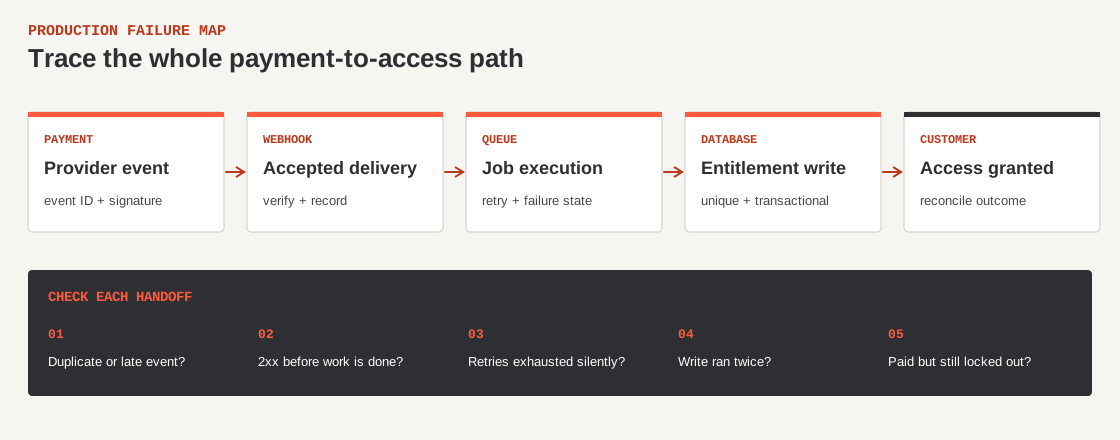
Production Failure Map: from payment to access
This is a realistic example, not a client incident. At every handoff, the operator needs evidence of the incoming event, completed work and the customer-visible result.
What to inspect
- Provider event and signature verification; duplicate and out-of-order delivery handling.
- Durable event identity before side effects, bounded retries and a visible failed-job state.
- Worker supervision, scheduler invocation and whether deploys restart workers.
- Transaction boundaries, entitlement uniqueness and a safe reconciliation path.
What not to do blind
- Replay failed jobs before checking whether their side effects already happened.
- Rotate webhook secrets or change queue drivers without mapping consumers.
- Run a schema change while old workers may still write the old shape.
- Replace the billing system because one failure path is poorly observed.
For a full explanation, read Payment succeeded, access denied. The Rescue Lab contains runnable, synthetic Laravel code that demonstrates duplicate delivery, bounded retries and reconciliation. It is explicitly a lab, not a customer case.
Engagement
The first 30 days of controlled ownership
The sequence is an example of how an engagement can be staged. It is not a guaranteed recovery schedule: an active incident, access dispute or data issue changes the order and scope.
See the real state
Confirm company access, deployed revision, current PHP/Laravel versions, incidents, error tracking, backups and critical customer paths. Stop routine changes if no one can explain the release path.
Make failure visible
Trace the highest-impact flow end to end. Add targeted checks for queue failures, scheduler completion and payment-to-access reconciliation. Prove a restore in an isolated environment.
Fix one bounded cause
Ship a small approved correction with a regression test and rollback. A webhook repair should prove duplicate delivery and replay behavior; a queue repair should prove failure is surfaced.
Assign durable ownership
Write the operating runbook, prioritize version and dependency work, agree a maintenance or upgrade scope, and hand the company a decision record with remaining unknowns.
A Tech Mitrise X-Ray provides a written risk register, business-rules map, support map, first safe change, test plan and costed next steps. It starts read-only. An emergency production fix, a full upgrade and ongoing on-call ownership require separately agreed access, scope and approval.
Decision support
Stabilize, upgrade or rewrite?
The choice follows the failure and the evidence. An upgrade becomes necessary when the installed release loses security fixes, required dependencies drop compatibility or the runtime cannot be safely supported. Even then, a stable release and rollback path come first.
| Situation | Stabilize | Upgrade | Rewrite |
|---|---|---|---|
| A paid customer has no access | Trace and repair the live fulfillment path | Only if the cause is an unsupported dependency | A rewrite cannot be the incident response |
| Framework or PHP support has ended | Contain exposure while planning | Usually a planned version path after compatibility checks | Only if the present architecture cannot meet the business need |
| Tests are sparse | Capture critical behavior before a change | Upgrade after a minimal safety net exists | High risk without a behavior map |
| The only developer left | Recover company ownership and release control | After a second engineer can operate it | Does not itself solve access or knowledge loss |
| Migrations and workers are coupled | Map mixed-version behavior and data changes | Sequence compatible releases | Consider only after a scoped comparison |
The Laravel 10 and Laravel 11 lifecycle pages provide version-specific sources. If a departing developer is the central issue, the inherited-codebase guide gives the first engineering sequence. The Yii service and migration guide address different framework decisions.
Proof
What our public evidence actually shows
The public Laravel Rescue Lab is a reproducible demonstration of a SaaS revenue-integrity failure, not an anonymized client story. Inspect its code and tests to judge the method. Case Records shows real company work, but we do not label those projects as Laravel rescues without evidence.
For an inherited app, we first verify who can deploy, restore and respond. We do not promise a zero-downtime upgrade, a 30-day fix or a retainer before seeing the deployed system. A triage call can decide whether a focused incident response or the written X-Ray is the right start.
Primary references checked 14 November 2026: Laravel support policy; queues and failed jobs; Stripe webhooks.
Questions
Questions before a Laravel rescue starts
Can you take over Laravel code your team did not write?
Yes, after a bounded review of source, production state, deployment, data and the business path. We do not claim to know an inherited system before that evidence is available.
Should we upgrade Laravel immediately?
An active customer-impacting failure needs stabilization first. If a version is unsupported, plan an upgrade promptly, but first check PHP, packages, tests, data migrations and rollback. The official release table determines the actual support window.
What if a payment webhook was delivered twice?
The handler should verify the provider signature and process an event idempotently, with a durable event identity and reconciliation path. Inspect the existing implementation before replaying or deleting a job.
Can you guarantee no downtime?
No responsible team can promise that before inspecting deployment and data constraints. We plan releases to minimize impact, rehearse the change and define what can and cannot be rolled back.
Do we need a retainer?
Not automatically. A focused incident fix, a written X-Ray or ongoing ownership can each be appropriate. The assessment determines the scope and the company retains its code and operating knowledge.
What should we provide for the first review?
A named decision owner, read-only repository and log access, current incident symptoms, and a person who knows the customer workflow. Do not send passwords, production secrets or customer records through a contact form.
A production problem deserves a traceable next step.
Tell us the customer-visible failure and what your team can verify today. A free 20-minute Risk Triage can establish whether you need immediate stabilization, a bounded diagnostic or a planned upgrade.