
Yii migration decision center
Should you migrate your Yii application at all?
Yii 1.1, Yii 2, Yii3 and Laravel are different engineering destinations. The safer question is which business capability must change, what evidence you have, and whether you can deploy and recover while the old system keeps serving customers.
Before choosing a destination
- Identify the deployed version and PHP runtime.
- Prove a recent restore and independent deployment.
- Write down the rules a replacement must preserve.
- Choose the smallest capability that could move safely.
Framework age creates a deadline. It does not choose the architecture for you.
The starting point
First separate support risk from migration preference
An end-of-life date means a version stops receiving a class of fixes; it does not make a running application shut off that day. The current official Yii release cycle distinguishes Yii 1.1, older Yii 2, newer Yii 2 and Yii3. Those distinctions change what an in-place version step can achieve.
| Generation | Official status, checked 14 Nov 2026 | Main constraint | First decision |
|---|---|---|---|
| Yii 1.1 | Maintenance branch; official end of life 31 Dec 2026 | Legacy APIs and often older PHP or extensions | Contain risk now; compare migration or bounded replacement with evidence |
| Yii 2.0.49 and older | Official end of life 23 Nov 2026 | Older PHP compatibility and missing later security fixes | Investigate a tested step to 2.0.50+ if compatible |
| Yii 2.0.50 and newer | Security-only phase begins 23 Nov 2026; end of life 23 Nov 2027 | Runtime and extension fit still determine the actual path | Maintain deliberately while planning the next supported architecture |
| Yii3 | Released 31 Dec 2025; separate package-based generation | Not a drop-in update for Yii 1.1 or Yii 2 | Evaluate as a new target architecture, alongside other options |
Check the exact installed version, not just “Yii 2.” A step from 2.0.49 to 2.0.50+ can be a bounded upgrade if PHP and extensions permit it. A move from Yii 1.1 to Yii 2 crosses a much larger boundary: the official Yii upgrade guide describes extensive changes in namespaces, components, models, identity and views. Yii3 is released, but it is another distinct generation, not a drop-in package replacement.
The site's Yii 1.1, older Yii 2 and newer Yii 2 pages give version-specific dates and sources. If ownership is uncertain, start with Yii application takeover before planning a migration.
Interactive guide
Which path is worth investigating?
Answer six questions about your current operating evidence. The result names a direction to investigate and shows the rule used. It cannot see your code, business rules or production data.
Browser-only decision aid
Migration Path Finder
No login, code upload or saved answers. Answers are calculated here without a form submission. With analytics consent, Clarity may count tool completion and printing; the answer area is masked. This is a route to investigate, not a diagnosis.
Check the installed package or deployed files, not a project proposal.
Not answeredUse the installed PHP version and vendor support status.
Not answeredThink login, billing, permissions and the workflow that earns revenue.
Not answeredHow quickly would a failure affect customers or revenue?
Not answeredInclude extensions, Active Record behavior, auth, views and jobs.
Not answeredA documented claim is weaker than a safe independent rehearsal.
Not answeredCurrent direction · verify first
Insufficient evidence to recommend a path
Why: A framework choice made without the current version, business path and recovery ability is guesswork.
Rule used: Any answer is unknown or unanswered.
Key risks
- A migration can hide an access or data-recovery gap.
- An apparently easy upgrade can break an untested workflow.
Missing proof
- framework version
- PHP/runtime support
- critical-workflow tests
- business criticality
- framework coupling
- independent deploy and restore
Next verification: Verify framework version in a company-controlled environment; then rerun the finder.
Professional help: A scoped technical assessment is appropriate when your team cannot establish these facts independently.
How the recommendation is chosen
- Any unknown answer means insufficient evidence.
- Missing independent recovery, an unsupported runtime, or a high-criticality system with no tests means stabilize first.
- An older Yii 2 release with recovery and some tests suggests a bounded in-place version step.
- Yii 1.1 with limited coupling and some tests calls for a scoped comparison of destinations.
- High coupling, Yii 1.1 with substantial coupling, or no tests favors incremental modernization.
- A current supported system with recovery and manageable coupling may be maintained while the next version is planned.
Decision framework
Six paths, with different failure modes
Maintenance can be a deliberate business choice; migration can be necessary when support, staffing or product constraints make the current state untenable. A rewrite is a separate investment case. Compare all three before estimating one.
| Path | When it may fit | Main risk | Proof to request |
|---|---|---|---|
| Maintain and contain | Critical workflows are stable; recovery works; a bounded support horizon is acceptable | Support deadlines and operating ownership still need named review | A dated risk register, test and restore cadence |
| Upgrade PHP or Yii in place | A supported target exists and extensions, tests and deploy path can be rehearsed | Compatibility gaps and mixed-version data or workers | Dependency matrix, safe-copy rehearsal and rollback |
| Modernize inside Yii | One fragile component can be isolated while the application remains valuable | New and old behavior may diverge | Interface boundary, characterization tests, owner |
| Migrate to Yii 2 or Yii3 | Team capacity and dependencies favor Yii and a major-architecture project is justified | A major generation is not an ordinary Composer update | Scoped capability and data migration plan |
| Move selected capabilities to Laravel | A bounded business capability and Laravel operating expertise both exist | Shared data and identity can create two sources of truth | Contract, data ownership and reconciliation tests |
| Replace the whole application | The product model itself must change and incremental paths have been compared | Undocumented rules, data and long parallel operation | Business case, complete behavior inventory, phased cutover |
A move to Laravel can be a sensible target if the team can operate it and a bounded capability has clean contracts. It is not automatically simpler than modernizing within Yii. A full replacement may be justified when the business model, architecture and operating needs have changed enough that incremental routes are more costly or hazardous—but that conclusion requires evidence, not a framework preference.
Dependency map
The migration is larger than the controllers
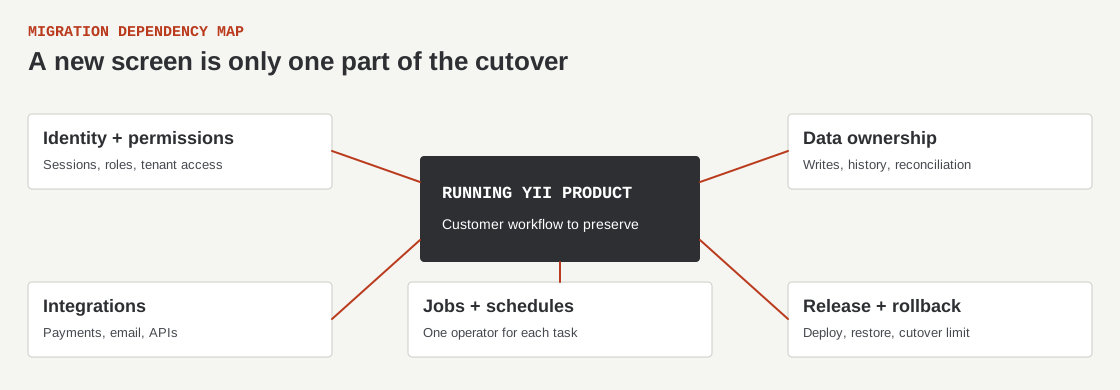
Data, identity and background work create the real cutover boundary. A new application may render the same screens while granting different permissions, writing different timestamps or failing to run a quiet nightly job.
Preserve meaning, not just rows
Record identifiers, null rules, timezones, audit history and the reports that read tables directly. Compare representative records before and after transformation. A row count alone cannot prove business equivalence.
Keep access rules coherent
Map login sessions, password hashes, roles, tenant boundaries and privileged actions. Decide whether old and new components share identity or use a bridge; test revocation and session expiry during the overlap.
Control parallel work
Schedulers, queues, webhooks and notifications must not run twice when two stacks are live. Give every job and data write a single accountable owner, plus a reconciliation path when an event is delayed.
Worked example
How a phased move can keep a way back
Consider a hypothetical Yii 1.1 subscription portal. The business wants to replace its reporting module, while checkout and entitlement are stable. This is an illustrative plan, not a Tech Mitrise client result or an estimate.
- Baseline: document one report's inputs, permissions and outputs; capture representative fixtures and current behavior. Verify source, deployment and an isolated restore.
- Boundary: expose a read-only report contract from the existing data owner. Keep writes in Yii; prohibit the new module from changing subscription state.
- Parallel check: run the new report on the same snapshots and compare totals, filters, tenant isolation and timezone behavior. Investigate differences before users see them.
- Limited release: route a small authorized user group to the new report with an immediate route-level fallback. Monitor latency, errors and discrepancy counts.
- Expand or revert: expand only when the agreed checks pass. Revert traffic to Yii if the new report fails. Because the new module has not written business data, rollback remains a routing decision rather than a risky data reversal.
A later write-capable capability needs a different plan. Once both systems write shared state, “rollback” may require reconciling new records instead of switching a route. This is why the easiest visible screen is not always the safest first migration slice.
Business decision
A checklist for the person funding the work
- Name the business outcomes and customer paths that cannot regress.
- Confirm exact deployed Yii, PHP and package versions against official support tables.
- Prove a second authorized engineer can deploy and restore away from production.
- Inventory custom extensions, direct SQL, jobs, integrations and identity rules.
- Capture representative data and edge cases before transforming any schema.
- Agree who owns each write while old and new code run together.
- Set a measurable cutover condition and a realistic rollback boundary.
- Compare maintenance, staged modernization and replacement on business value and operating risk.
If the company cannot prove recovery, the support deadline is near, auth and data ownership cross proposed boundaries, or a rewrite quote rests on undocumented assumptions, a scoped technical assessment can prevent a much larger mistaken commitment. The Tech Mitrise X-Ray gives a written risk and test plan; the free Risk Triage can determine whether that is the right first step.
Need help operating the current Yii app?Check present software riskSee documented experience
Questions
Migration questions that deserve a precise answer
How much does a Yii migration cost?
No credible price follows from a framework label. Scope depends on custom code, extensions, data quality, integrations, testability and whether both systems must run together. A paid diagnostic should price specific phases and assumptions rather than promise a generic per-page rate.
How long does Yii 1.1 to Yii 2 or Yii3 take?
The official Yii 1.1-to-2 guide describes a substantial architecture change, not a routine package update. Time depends on the amount of behavior to preserve, the number of dependencies and the release strategy. Estimate only after a bounded discovery slice.
Can we migrate without downtime?
Sometimes a staged cutover can limit downtime, but data writes, identity sessions and external integrations can force a planned pause. Rehearse the cutover and define what rollback means after new writes begin. Do not promise zero downtime before inspecting these constraints.
Should we choose Laravel because hiring is easier?
Staffing is one factor, not the only one. Compare your team’s capability to operate the target, the amount of reusable business logic, ecosystem fit, data boundaries and the cost of running two systems during transition.
Is Yii3 a direct upgrade from Yii 2?
No. Yii3 is a distinct, package-based generation. Evaluate it as a target for a scoped migration, including authentication, persistence, extensions and operating model. A current Yii 2 application can also be maintained while that choice is made.
Do we need to rewrite the database?
Often not. Preserving a stable schema can reduce cutover risk, but a shared schema can also trap two applications in hidden coupling. Decide table by table which application owns writes, how data is validated and how history is preserved.
What if we have no tests?
Start by documenting and checking the few workflows that matter most. A migration without a behavior baseline may turn old undocumented rules into live defects. The first tests can be characterization checks rather than a full suite.
What if the app is already failing?
Stabilize the customer-impacting path and protect data first. A migration program is not an incident response. Once the system can be operated and recovered, compare long-term routes.
Primary references checked 14 November 2026: Yii release cycle; Yii 1.1-to-2 guide; Yii3 release announcement. Recheck official timelines before publication and client recommendations.
Make the migration decision from evidence, not momentum.
If your team cannot establish the deployed version, recovery path or critical behavior, a 20-minute Risk Triage can identify the smallest useful diagnostic step. You retain the choice to maintain, migrate, hire or use another team.