
Software continuity · 2026-11-15 · 15 min read
Your Only Developer Left. What Do You Secure in the First 72 Hours?
A practical emergency plan for SaaS founders to regain control of source code, cloud access, billing, deployments and backups without breaking production.
Your first 15 minutes

Mohit Tanwani
Founder, Tech Mitrise
The first answer
If your only developer has left, first establish who is authorized to act for the company and whether customers are affected right now. Pause nonessential production changes. Identify the company-controlled accounts behind source code, hosting, domain, payments, data and communications; record who can recover each one. Have an authorized engineer compare the live deployment with the repository, locate recent backups, and test a restore in an isolated environment. Do not delete accounts, rotate every key, or attempt a production restore on instinct: those actions can break the very system you are trying to protect. If you see evidence of compromise or malicious activity, use your incident-response process and get qualified help immediately. The goal of the next 72 hours is a verified map of what you control, what you cannot confirm, and who owns each safe next action. Use the 72-Hour Command Center below as you work.
The first job is to prove the business can still operate, deploy and recover without the person who built the software. Hiring or rewriting can wait until that proof exists.
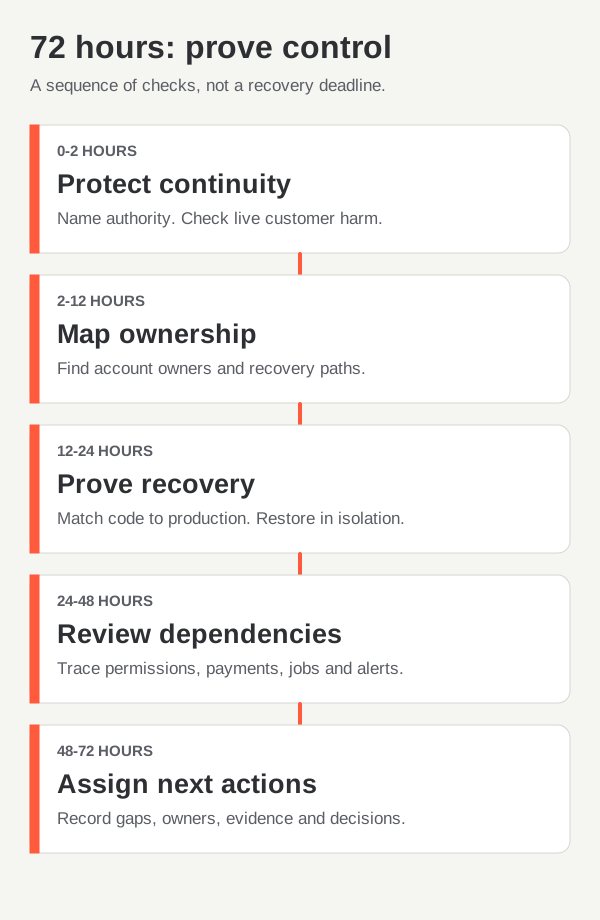
Choose your scenario before changing access
The developer is leaving cooperatively
Use the notice period for a bounded handover. Ask a second authorized engineer to watch the developer build from a clean checkout, identify the deployed revision, walk through one release and rollback, and explain the highest-risk scheduled jobs. Transfer account ownership through each provider's supported process. Agree on an end date for access, then revoke individual access and rotate shared credentials in a tested sequence. A recording helps, but the second engineer must perform the steps independently.
The developer has departed but is contactable
Preserve the current production state first. Send a short written request for the repository list, account ownership, deployment path, backup location, open incidents and support boundaries. Verify each answer inside company-controlled accounts. If the person can help, pay for a limited handover with clear deliverables and authorization; do not wait for it before mapping what your team can access today.
The developer is unreachable or ownership is disputed
Work only through accounts and recovery channels the company is authorized to use. Preserve contracts, invoices, provider records, deployment logs and communications. Ask providers about their documented recovery process; do not enter someone else's personal account or attempt to bypass MFA. Involve legal counsel for ownership disputes and a qualified incident responder if there are signs of compromise. The operational goal is containment and evidence, not a rushed claim that everything has been recovered.
The first 72 hours, in a safe order
Hours 0-2: protect continuity
Name one company decision owner and one technical responder. Check customer-facing login, checkout, access provision, support intake and current alerts. Record the last known good deployment. Freeze routine releases and destructive maintenance until someone can explain their effect. If there is active harm, use the incident process; preserving evidence and reducing exposure may take priority over the normal handover sequence. Tell customer-facing staff what is known and who may communicate externally.
Hours 2-12: map authority and dependencies
Create an inventory with provider, registered owner, billing owner, administrators, recovery email and phone, MFA holders, renewal date and the service's business purpose. Start with source control, cloud, registrar/DNS, payment processor and primary database. A login from the departed developer's laptop is not company control. GitHub recommends multiple organization owners, and AWS treats root recovery contacts as a continuity control.
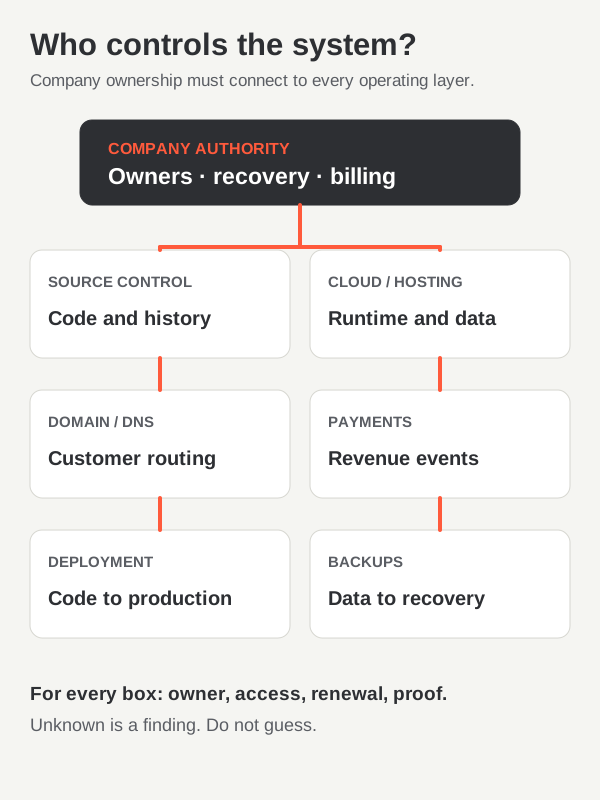
Hours 12-24: prove code and recovery
Have an authorized engineer inspect full repository history and compare a release artifact or commit with what runs in production. Locate database backups, configuration backups and the encryption keys needed to use them. Test a recent restore in an isolated environment and validate representative records and application behavior. A green backup dashboard proves that a job ran; it does not prove you can restore. AWS Backup documents restore testing for exactly this distinction. Record the release and rollback paths without using production as the test environment.
Hours 24-48: review live permissions and revenue paths
Map human accounts, service accounts, deploy keys, webhook secrets and environment variables before rotating anything. Review who can deploy and how that authority is granted. Reconcile a recent payment with webhook delivery and the customer's actual access; a successful payment alone does not prove the product fulfilled it. Check email and SMS delivery, monitoring recipients, failed queues, cron jobs and renewals. A suspicious identity or credential calls for controlled containment with a responder, not a blanket delay.
Hours 48-72: write a decision record
For each unresolved item, record the business consequence, proof missing, current status, accountable person, next action and review time. Separate blocked from unknown: a failed restore is different from a restore nobody has tried. Choose whether to maintain the current system, recover access, stabilize a failure, arrange a handover, hire, or obtain an independent assessment. Put that choice in writing so the next engineer has a boundary, not a vague instruction to “take over.”
Twelve control areas to verify
Ask the same five questions of every area: what must we know, what proves it, what could fail, what should not be changed blindly, and who owns the next step? The table is deliberately concise. The Command Center below gives each check a status and proof standard.
| Area | Know and prove | Failure and change boundary | Next owner |
|---|---|---|---|
| Source control | List every repo. A company identity can see history, settings and branches. | Personal ownership or missing commits; do not force a transfer before checking permissions, hooks and deploy keys. | Engineering lead |
| Cloud / hosting | Know account owner, recovery contacts, MFA and running resources; verify independent company admin access. | Lost root recovery or unidentified workloads; do not terminate unfamiliar resources. | Founder + cloud admin |
| Domain / DNS | Identify registrar and DNS provider, renewal, nameservers and current records in company accounts. | Expired domain or broken routing; do not change nameservers during inventory. | Operations |
| Database | Know production instance, owner, engine, encryption and connection path; inspect authorized console records. | Wrong instance or lost key; do not run migrations or exports against production casually. | Database / engineering lead |
| Backup and restore | Know location, retention and key owner; restore a recent copy in isolation and validate it. | Unusable or incomplete backup; never restore over production as a first test. | Engineering lead |
| CI/CD | Find pipeline, artifact, deploy identity, approvals and rollback; match a release to production. | A merge may deploy automatically; do not “test” a pipeline with a blind merge. | Engineering lead |
| Secrets | Inventory storage and consumers without copying values; confirm authorized access to the manager. | A rotation can disable workloads; do not rotate all secrets at once. | Security lead |
| Payments | Know processor owner, settlement, webhook endpoint and signing secret; reconcile payment to access. | Paid customers may remain locked out; do not disable webhooks or replace keys blindly. | Engineering + finance |
| Email / SMS | Know provider, sending identity, delivery failures and renewal; inspect recent delivery evidence. | Receipts or login codes may stop; do not remove an “unused” sender. | Operations |
| Monitoring | Know what alerts fire and who receives them; test one safe notification. | Alerts may go to the former developer; do not silence monitors during handover. | Operations |
| Cron / queues | List jobs, workers and failed queues; connect each to a business outcome. | Invoices or access changes may stop silently; do not shut down unfamiliar workers. | Engineering lead |
| Billing / renewals | Know payer, renewal date, failure notices and card owner for every critical provider. | A lapsed card can stop service; do not cancel duplicate-looking plans before dependency review. | Finance + operations |
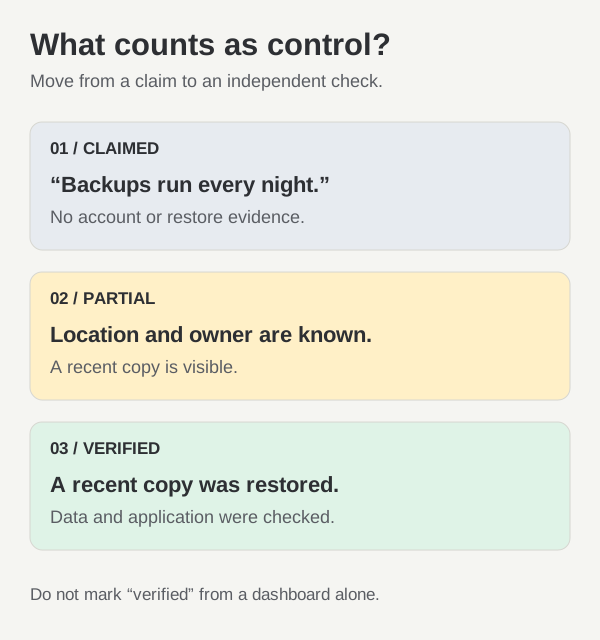
Use the 72-Hour Command Center
Set a status for each task. “Verified” means the stated proof exists; “Unknown” means you cannot confirm it. For “Not applicable,” explain why. The tool highlights critical blocked and unknown controls without inventing a numerical security score. It keeps entries in this browser only and offers a blank downloadable emergency kit if you prefer paper. Use your company's approved workspace for actual account names, evidence links and deadlines.
Free interactive tool
72-Hour Command Center
Record what you can prove, not what you hope is true. No login. No details leave this browser.
Progress is saved only in this browser when local storage is available. Do not enter passwords, secrets, customer data, or sensitive logs. These time windows guide triage; they are not a recovery deadline.
Rule: red if any critical control is blocked; otherwise unknown if any critical control cannot be confirmed; otherwise amber while a critical control remains open; green only when every critical control is verified or has an explained exception. A green label is not a security guarantee.
Next checks to assign
- Name an authorized decision owner — Founder; Not started
- Record a temporary change boundary — Founder; Not started
- Check for active incident indicators — Security or engineering lead; Not started
- Identify the live customer-critical path — Founder; Not started
- Start a company account inventory — Founder; Not started
Work through one time window at a time. Open any phase to review or update its checks; unresolved critical controls remain visible in the summary above.
Hours 0-2Protect continuity and establish authority0 / 4 resolved
Authority · Critical
Name an authorized decision owner
Verified when: A named company officer can approve account recovery, access changes, and emergency spend.
Not enough: Someone says the founder probably has access.
Suggested owner: Founder
Production · Critical
Record a temporary change boundary
Verified when: The team knows who may deploy and which changes need explicit approval.
Not enough: Everyone assumes no one will deploy.
Suggested owner: Founder
Security · Critical
Check for active incident indicators
Verified when: An authorized responder reviews current alerts, access anomalies, and customer impact; an incident is escalated.
Not enough: The site appears to load.
Suggested owner: Security or engineering lead
Revenue · Critical
Identify the live customer-critical path
Verified when: A named owner can state the login, payment, access, and support flows that cannot pause.
Not enough: The product is 'working.'
Suggested owner: Founder
Hours 2-12Map ownership and recovery0 / 5 resolved
Ownership · Critical
Start a company account inventory
Verified when: Provider, legal owner, admin, recovery contact, MFA holder, and renewal date are recorded for each critical service.
Not enough: A shared password spreadsheet exists.
Suggested owner: Founder
Cloud · Critical
Verify cloud account recovery authority
Verified when: Company-controlled recovery email, contact phone, MFA path, billing owner, and an authorized admin are confirmed.
Not enough: A developer can log in.
Suggested owner: Founder and cloud admin
Domain and DNS · Critical
Confirm registrar and DNS ownership
Verified when: The company can access registrar and DNS consoles and sees current renewal and nameserver settings.
Not enough: The domain resolves today.
Suggested owner: Founder and operations
Billing
Find renewals that could stop service
Verified when: Cloud, registrar, email, SMS, monitoring, and payment-platform billing contacts and payment methods are identified.
Not enough: Invoices were paid last month.
Suggested owner: Finance and operations
Handover
Establish the departure scenario
Verified when: Availability, notice period, account ownership, and a written authorized contact path are recorded.
Not enough: We expect the developer to reply.
Suggested owner: Founder
Hours 12-24Prove code and recovery paths0 / 5 resolved
Source control · Critical
Verify company access to every repository
Verified when: An authorized company account can view full history, branches, and repository settings; missing repos are listed.
Not enough: A zip file was delivered.
Suggested owner: Engineering lead
Production · Critical
Match production to a source revision
Verified when: The deployed version, environment, and release record match an identifiable source revision.
Not enough: The main branch looks current.
Suggested owner: Engineering lead
Backup · Critical
Locate backup copies and retention
Verified when: An authorized owner can identify the latest usable copy, storage account, encryption key owner, retention, and recovery limits.
Not enough: The dashboard says successful.
Suggested owner: Engineering lead
Restore · Critical
Prove an isolated restore
Verified when: An authorized engineer restores a recent copy into an isolated environment and checks representative data and application usability.
Not enough: A backup file exists.
Suggested owner: Engineering lead
CI/CD · Critical
Document deploy and rollback routes
Verified when: The pipeline, approvals, service identity, artifact, and rollback steps are identified without testing on production.
Not enough: Someone recalls how deployments work.
Suggested owner: Engineering lead
Hours 24-48Review live dependencies safely0 / 6 resolved
Secrets · Critical
Inventory secret locations and consumers
Verified when: The authorized team knows where secrets are stored and which workloads use them; no secret values are copied here.
Not enough: Every key should be rotated now.
Suggested owner: Security or engineering lead
Access · Critical
Plan least-privilege access changes
Verified when: Human and machine identities, dependencies, and revocation order are reviewed by an authorized owner.
Not enough: The old account was deleted first.
Suggested owner: Security or engineering lead
Payments · Critical
Check payment-to-access delivery
Verified when: Recent paid transactions, webhook delivery, downstream entitlement, and alert ownership reconcile.
Not enough: Stripe shows successful payments.
Suggested owner: Engineering and finance
Email and SMS
Check transactional messaging
Verified when: Provider owner, sending domain, API usage, recent delivery failures, and renewal are known.
Not enough: A test email arrived once.
Suggested owner: Engineering and operations
Monitoring · Critical
Verify alerts reach a current responder
Verified when: A recent alert test or incident shows the current owner received and acknowledged it.
Not enough: Monitoring is installed.
Suggested owner: Operations
Cron and queues
Map scheduled and background work
Verified when: Jobs, workers, owners, failure queues, and business effects are documented before any shutdown.
Not enough: The jobs look unused.
Suggested owner: Engineering lead
Hours 48-72Assign the next safe actions0 / 4 resolved
Priorities · Critical
Rank unresolved risks by consequence
Verified when: Blocked and unknown controls have a business impact, urgency, and named next action.
Not enough: A single green score hides unknowns.
Suggested owner: Founder and engineering lead
Ownership
Assign an owner and deadline per gap
Verified when: Each unresolved control has a named accountable person and a next review date outside this browser tool.
Not enough: The checklist was shared.
Suggested owner: Founder
Handover
Capture a bounded handover
Verified when: If available, the departing person walks a second engineer through one build, deploy, rollback, and incident path.
Not enough: A long recorded call was held.
Suggested owner: Engineering lead
Next step
Choose the smallest safe next step
Verified when: A written decision names maintain, recover access, stabilize, assess, hire, or stage modernization, with its evidence.
Not enough: A rewrite was approved by instinct.
Suggested owner: Founder
Action by owner
| Suggested owner | Unresolved work | Next step |
|---|---|---|
| Founder | Name an authorized decision owner; Record a temporary change boundary; Identify the live customer-critical path; Start a company account inventory; Establish the departure scenario; Assign an owner and deadline per gap; Choose the smallest safe next step | Assign a named person and review date in your own secure workspace. |
| Security or engineering lead | Check for active incident indicators; Inventory secret locations and consumers; Plan least-privilege access changes | Assign a named person and review date in your own secure workspace. |
| Founder and cloud admin | Verify cloud account recovery authority | Assign a named person and review date in your own secure workspace. |
| Founder and operations | Confirm registrar and DNS ownership | Assign a named person and review date in your own secure workspace. |
| Engineering lead | Verify company access to every repository; Match production to a source revision; Locate backup copies and retention; Prove an isolated restore; Document deploy and rollback routes; Map scheduled and background work; Capture a bounded handover | Assign a named person and review date in your own secure workspace. |
| Engineering and finance | Check payment-to-access delivery | Assign a named person and review date in your own secure workspace. |
| Operations | Verify alerts reach a current responder | Assign a named person and review date in your own secure workspace. |
| Founder and engineering lead | Rank unresolved risks by consequence | Assign a named person and review date in your own secure workspace. |
| Finance and operations | Find renewals that could stop service | Assign a named person and review date in your own secure workspace. |
| Engineering and operations | Check transactional messaging | Assign a named person and review date in your own secure workspace. |
What not to do under pressure
- Do not order a full rewrite on day one. You may discard working business rules before anyone has mapped them. Stabilize the current revenue path and decide from evidence.
- Do not rotate every production secret at once. A safe rotation identifies consumers, supports overlap when possible, tests one change and has a rollback. Rotate urgently when compromise is suspected, under incident leadership.
- Do not delete the departed person's access before you understand operational dependencies. A personal token may be running a deploy or backup. Establish replacement access, then revoke promptly on an approved plan. Active misuse is an incident and may require immediate containment.
- Do not restore an untested backup over production. Practice in isolation and confirm that the data, keys and application work together.
- Do not hand a replacement engineer unrestricted credentials. Use named accounts, read-only access first, and approved elevation for specific changes.
- Do not shut off unfamiliar cron jobs or queues. A quiet worker may issue invoices, grant product access or send reminders.
- Do not accept “successful backup” as recovery proof. The evidence is a usable restore, not a status badge.
- Do not access a personal GitHub, email or cloud account without authorization. Use provider recovery processes and qualified counsel when rights are disputed.
After 72 hours: week one and month one
In the first week, complete the inventory, resolve the most consequential access gaps, and have a second engineer reproduce the product in a safe environment. Document one customer-critical path end to end, including alerts, support escalation, deployment and rollback. Rehearse the restore before accepting a handover. If the system is already failing, stabilization takes precedence over a tidy transition document. The first five days in an undocumented codebase provide a deeper engineering sequence.
In the first month, remove single-person ownership of critical accounts, test recovery contacts and MFA alternatives, and set a recurring restore drill. Make release authority explicit. Capture hidden business rules as tests where practical. Review renewals and alert routing. A new hire can improve the system once the company can see what it owns and can recover from a mistake.
Choose the next move from the evidence
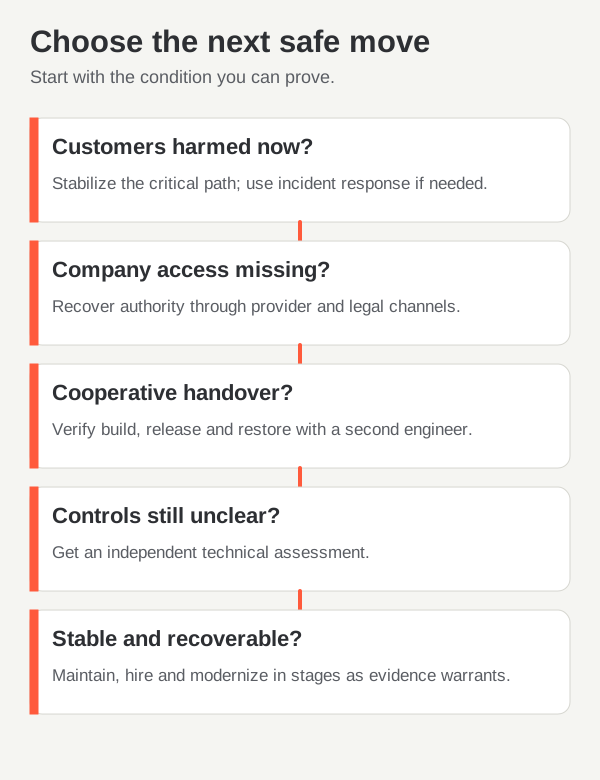
Maintain the existing system when customer flows are stable, access is company-controlled and recovery is demonstrated. Use a bounded handover when the departing developer is available and a second engineer can verify each step. Hire a replacement engineer when daily ownership is needed and the operating map is good enough for a safe start. Obtain an independent assessment when the repo, deployed state and business dependencies disagree. Stabilize first when customers are affected now. Modernize in stages only after the critical path, tests and rollback are understood. These choices can overlap; none requires Tech Mitrise.
If you cannot tell who controls production or whether a restore would work, request a 20-minute Risk Triage. The call is a small way to identify the next safe diagnostic step. If a deeper independent map is needed, see what the Tech Mitrise X-Ray examines. You keep the decision whether or not you work with us.
Frequently asked questions
Can a company operate without its original developer?
Yes, if company-controlled accounts, a reproducible build, a release path, monitoring and recovery are independently usable. A running website alone does not establish that.
What if the source is in the developer's personal GitHub account?
Ask for an authorized transfer to a company organization, then verify collaborators, secrets, webhooks and deploy keys. GitHub's transfer documentation explains that some access and integrations persist after a transfer. If ownership is disputed, consult counsel; do not enter the personal account without permission.
What if we cannot access AWS?
Identify the registered root email, company contact phone, MFA holders and existing authorized administrators. Use AWS's documented root recovery path or AWS Support. Never assume access to the developer's personal inbox or device is authorized.
How do we know backups work?
An authorized engineer restores a recent copy into an isolated environment, checks representative data and runs the key application path. Record the backup age, restore duration, missing pieces and who holds encryption keys.
Should we rebuild the application?
Only after you know which business behavior must survive, what is failing, what can be repaired and how changes can be rolled back. A rewrite is a later investment decision, not an emergency access plan.
What if the developer refuses to cooperate?
Preserve the record, use company-owned accounts and provider processes, and obtain legal advice on rights and contracts. If there is evidence of malicious activity, activate incident response. Do not retaliate by making uncontrolled production changes.
How quickly can another engineer take over?
There is no reliable universal number. A clean repo, known production revision, documented dependencies and tested restore can make a short handover feasible; missing access or disputed ownership can dominate the timeline. Ask the incoming engineer to state what they can verify before promising a date.
What should a new CTO inspect first?
The revenue-critical customer path, actual deployed revision, account authority, backup restore, release and rollback route, and live alerts. Then compare those findings with the founder's assumptions and assign owners to gaps.
Sources and scope
This is an operational guide, not an ownership ruling or incident-response playbook. Provider procedures can change. Use current GitHub organization guidance, Google Cloud continuity guidance, AWS root security, AWS restore testing, and Stripe's separate API-key and webhook-secret guidance for provider-specific steps.
Written by Mohit Tanwani
Founder of Tech Mitrise. He does the rescue and upgrade work described here. 10+ years building and rescuing production software, including incident response for teams down to their last engineer.
About the founderThis is general operational guidance, not a client incident, legal opinion or substitute for a qualified incident responder.